Chromyne for Salons: Proof Before the First Brush.
A B2B web app for salons and makeup artists. Capture a client photo at the chair, choose a look, and show realistic AI previews in under thirty seconds — before any work starts. Designed, built, and run by our team.
Live at salon.chromyne.app · 17 pages, marketing site and full product · $99 to $349 per month with a 7-day free trial · in pilot.
The Client Cannot Picture It Yet.
Every appointment starts with a conversation about something neither person can see. The stylist describes a result; the client tries to imagine it on her own face. A reference photo of somebody else only half helps, because the answer depends on the face in the chair.
So the client hesitates, or picks the safe option she has had before, or agrees to something bolder and is quietly disappointed when the chair turns round. None of those is a good outcome for the business either: hesitation costs time, the safe option costs revenue, and disappointment costs the next booking. The stakes are highest in bridal and event makeup, where the work happens once, on a schedule, with no second attempt.
Capture, Choose, Preview.
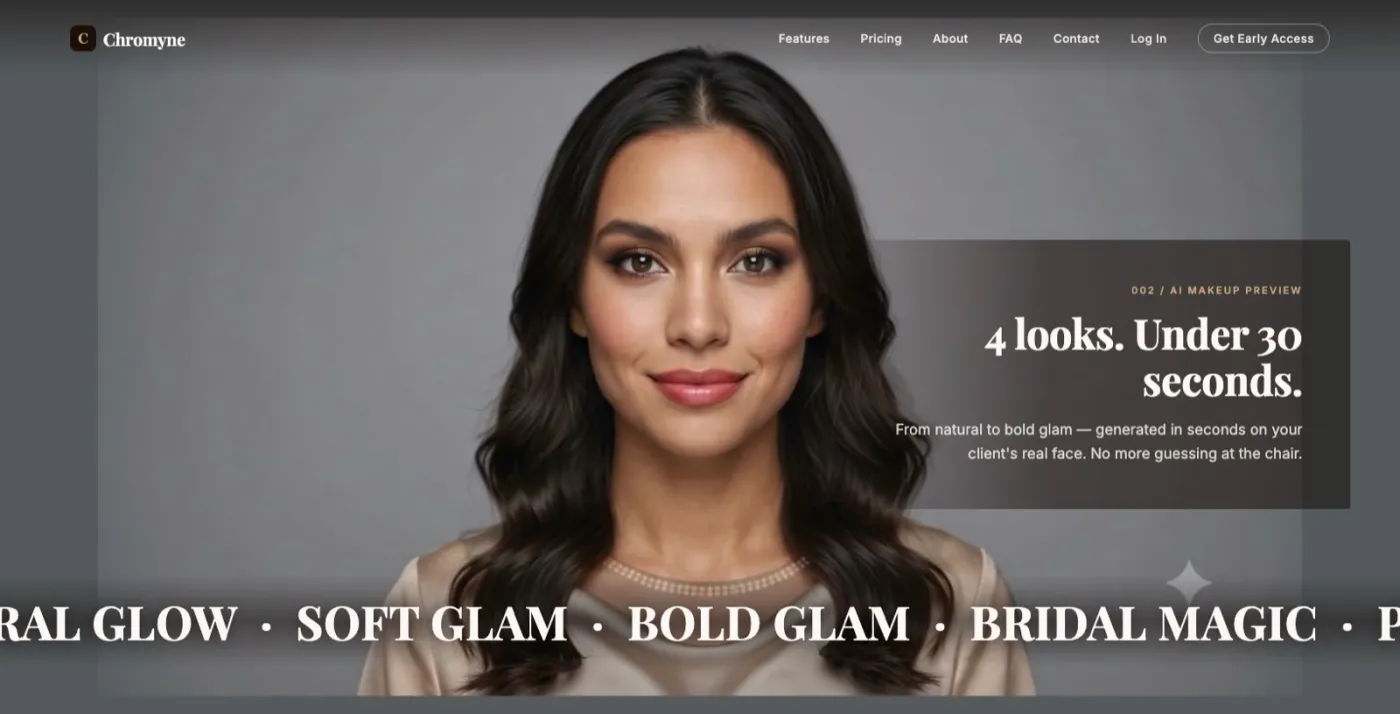
The whole loop happens at the chair. The stylist takes a photo of the client on a tablet, picks a direction — natural glow, soft glam, bold glam, or bridal — and hands back a set of realistic previews within seconds. The conversation stops being descriptive and becomes a choice between things you can both look at.
Around that thirty seconds sits an actual product, not a demo: sign-up, sign-in and password reset, a dashboard, client records with an add-client flow, billing, and a referral programme — plus the marketing site, FAQ, about, contact and legal pages. Seventeen pages in total. A salon owner can find it, understand it, sign up, pay, use it daily, and refer a peer without ever needing us in the loop, which is the part that separates a product from a prototype.
Same Pipeline. Different Buyer.
This did not start as a salon product. It started as Chromyne, the consumer app — a selfie, a quiz, a personalised colour report, $9.99 a month. The engineering underneath is largely the same. What changed was who we pointed it at.
A consumer buys a nice-to-have and churns when the novelty fades. A salon buys a tool that sits between a hesitant client and a booked service, and keeps paying for as long as it earns its place in the workflow. That is a different job, so it carries a different price: $99, $199 or $349 a month instead of $9.99, with a 7-day free trial to get the first look in front of somebody. It also implies a different order of attack — bridal and event makeup artists first, where the stakes and the ticket are highest, then solo stylists, then small salons of two to five chairs.
The transferable lesson is the one we bring into client work: the expensive asset is usually the pipeline, not the app around it. Before building something new, it is worth asking which other buyer would pay considerably more for the same capability wearing a different interface.
Reuse Where It Counts.
Almost nothing here was rebuilt. The parts that were expensive to get right are shared with the consumer app; only the surface in front of the stylist is new.
- Front end
- A static multi-page web app — no install, no app store, opens in the browser on whatever hardware the salon already owns.
- At the chair
- Designed for an iPad held in one hand: large targets, few steps, and a flow a stylist can run mid-appointment without breaking the conversation.
- AI
- The same server-side pipeline that powers the consumer Chromyne app, repointed at the salon use case.
- Backend
- Shared with the consumer app, extended with the accounts, client records, and billing a B2B product needs.
- Looks
- Four directions — natural glow, soft glam, bold glam, and bridal.
- Pricing
- $99, $199, or $349 per month, after a 7-day free trial.
Live, and Honestly Still a Pilot.
The site is up, the product works end to end, and the call to action on it says "Get Early Access" — because that is genuinely the stage it is at. It is taking early-access sign-ups while we work with the first users.
We are not going to put customer counts, revenue, or conversion figures on this page. A pilot does not have numbers worth quoting, and a case study that invents them is worth less than one that says so. What it does show is a second commercial product standing on the foundation of the first — designed, built, shipped, priced, and kept running by the same team.
One Engine Can Serve More Than One Market.
If you already have something working and suspect there is a better-paying buyer for it, that is a conversation worth having. See how we run app and web development, or look at the rest of our work.